Introduction to Machine Learning
Notes from the summary of COMP3010 Lecture 1, labs, and online resources.
Fields of AI
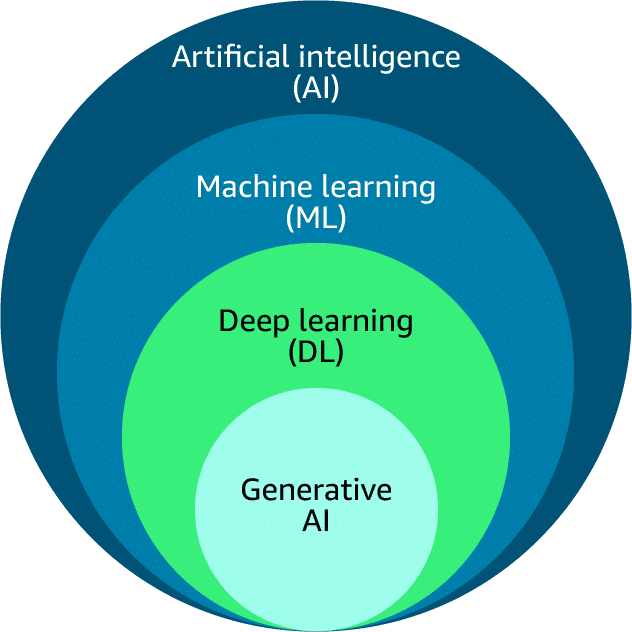
Understand the similarities and differences between AI, ML, deep learning, and generative AI
-
AI is a broad field that encompasses the development of intelligent systems capable of performing tasks that typically require human intelligence, such as perception, reasoning, learning, problem-solving, and decision-making.
-
ML is a type of AI for understanding and building methods that make it possible for machines to learn. These methods use data to improve computer performance on a set of tasks.
-
Deep learning uses the concept of neurons and synapses similar to how our brain is wired.
-
Generative AI is a subset of deep learning because it can adapt models built using deep learning, but without retraining or fine tuning.
Definition of Meachine Learning
ML is the study of computer algorithms that can automatically make and improve predictions based on data.
ML algorithms build a model based on sample data(training data), to make predictions or decisions without being explicitly programmed to do so.
ML is data-driven ML models learn from supervision or feedback to predict better
The machine learning process starts with collecting and processing training data. Bad data is often called garbage in, garbage out, and therefore an ML model is only as good as the data used to train it.
ML algorithm
In supervised learning the algorithms are trained on labeled data. The goal is to learn a mapping function that can predict the output for new, unseen input data.
Unsupervised learning refers to algorithms that learn from unlabeled data. The goal is to discover inherent patterns, structures, or relationships within the input data.
In reinforcement learning, the machine is given only a performance score as guidance and semi-supervised learning, where only a portion of training data is labeled. Feedback is provided in the form of rewards or penalties for its actions, and the machine learns from this feedback to improve its decision-making over time.
ML Approaches
Supervised Learning
- Classification: Assigning input data into predefined categories or classes.
Example: Email spam detection.
Unsupervised Learning
- Clustering: Grouping similar data points together without labels.
Example: Customer segmentation in marketing. - Dimensionality Reduction: Reducing the number of input variables while preserving essential information.
Example: Principal Component Analysis (PCA) for visualization.
Self-Supervised Learning
- Learning to predict parts of the data from other parts without manual labeling.
Example: Predicting a missing patch in an image.
Reinforcement Learning
- Learning through interactions with an environment using rewards and penalties.
Examples: Autonomous driving, playing board or video games.
Other Learning Paradigms
- Semi-Supervised Learning: Combines a small amount of labeled data with a large amount of unlabeled data.
- Federated Learning: Distributed training across multiple devices without centralizing data.
- Meta Learning: Learning how to learn across multiple tasks.
- Transfer Learning: Adapting a pre-trained model to a new but related task.
Leave a comment